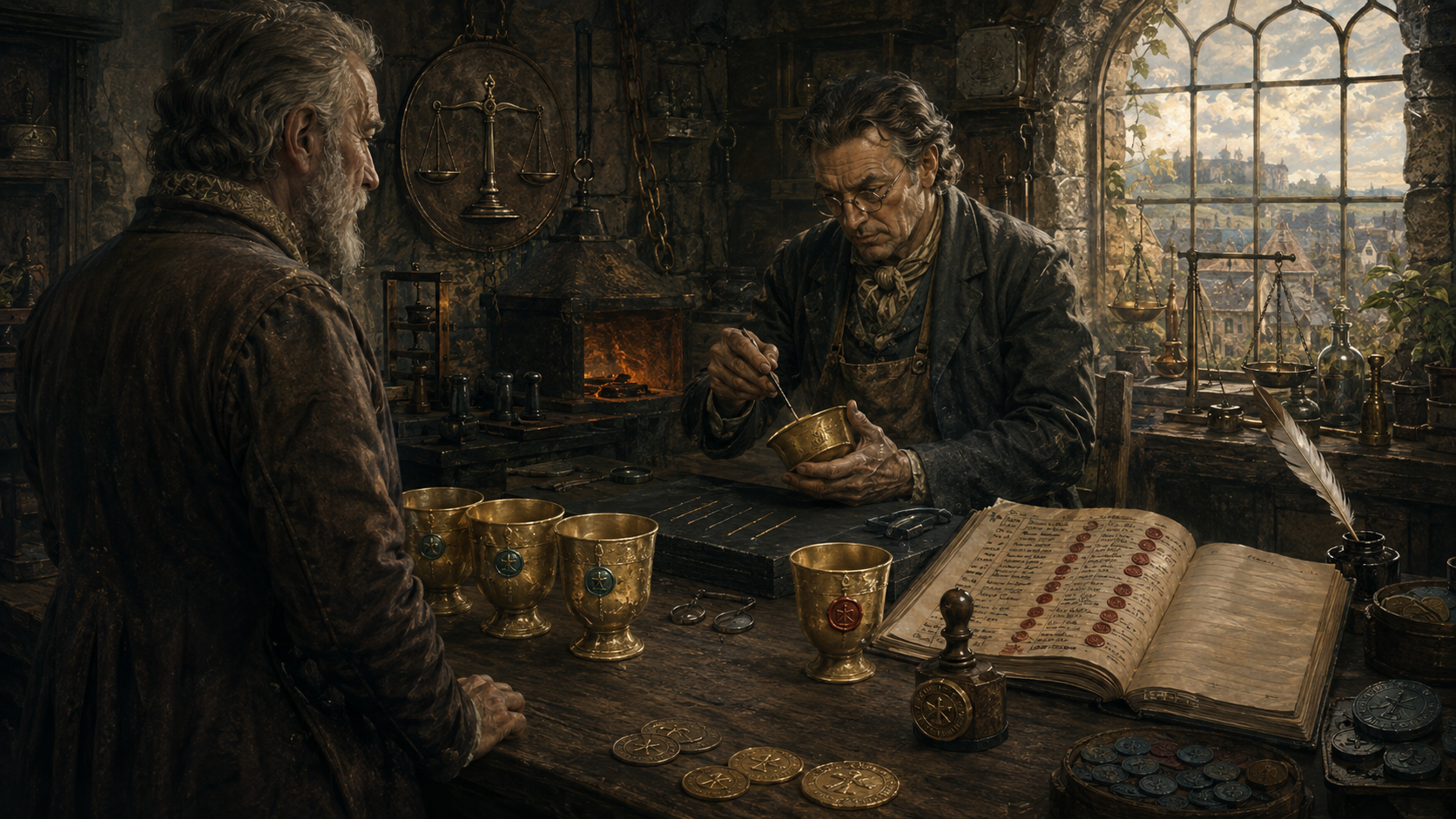
A goldsmith worked at the end of a street of goldsmiths, and his gold was honest.
He knew it was honest because he had refined it himself, and he stamped each finished piece with his own mark: a small hammer, struck neatly beside the rim. Anyone who knew him knew the mark. That was the difficulty. His trade had grown beyond the people who knew him.
A merchant came from a country three weeks distant and asked to buy a set of cups.
“How do I know the metal?” the merchant said.
The goldsmith showed him the mark. The merchant was polite about it. “That is your hammer,” he said, “on your cup, vouched for by you. I have four such assurances in my saddlebag from four other smiths, each of whom stamped his own honesty into his own metal, and one of them sold me brass.” He set the cup down. “I do not doubt you. I am telling you that your word about yourself cannot travel. It has to be carried by you, and you are not coming with me.”
The goldsmith had never thought of it in those terms — that his reputation was a thing which existed only within the distance a man could walk in a day and still find someone who knew his face.
So he took his cups to the assay hall.
It was an old building at the top of the street, and it sold nothing. The assayers were forbidden the trade entirely — no shop, no dealing in metal, no share in any smith’s house. A man who wished to judge gold had to give up selling it, and most were not willing, which was rather the point.
The assayer scraped a little from the foot of each cup, where the mark would cover the wound, drew the scraping across a piece of black stone beside streaks from needles of known alloy, and held it to the window to compare the colors. Then he took the scrapings to the furnace and burned away everything that was not gold, and weighed what remained against what had gone in.
While the fire did its work the goldsmith found a book on the table, very thick, and opened it. It was full of refusals. Names, dates, pieces returned, standards missed and by how much — page after page of other men’s failures, kept in a fair hand and open on a table where anyone might read it.
“You keep the ones that fail,” he said.
“We keep them chiefly,” said the assayer. “The mark on a cup means nothing unless it might have been withheld. If I passed every piece brought to me, my mark would say only that a piece had been brought.” He turned a page. “This book is the reason the mark is worth striking. Without it I am a man with a hammer and an opinion.”
Three of the goldsmith’s cups took the mark. The fourth was refused — a little short of the standard, from a crucible he had rushed — and he argued, because every man argues, and the assayer heard him out and refused it again and wrote it in the book with his name beside it. The cup went back to the crucible. It cost him a week.
He asked, at the end, what the assayer earned by it.
“A fee for the assay,” the assayer said. “The same whether I strike the mark or withhold it. If I were paid more for passing, you would already know what my mark was worth — and if I strike it falsely I am not dismissed, I am ruined, publicly. The mark carries the weight of what it costs me to be wrong.”
Years later the cups were in a house in the merchant’s country, and the goldsmith was long dead, and a woman who had never heard his name turned one over to look at the foot.
There were two marks. One was a small hammer, which told her nothing at all.
The other told her that on a particular day, in a hall that sold no gold, a man who could not profit from the answer had tested this metal against a fixed standard, had been free to refuse it, and had not.
She did not have to trust the goldsmith. She did not have to find him, or write to him, or take anyone’s word about his character. He was dust, and the cup was still good, and she could read why without asking permission of anyone.
Moral: A mark is worth what it costs to withhold. Let the judge sell nothing he judges, keep his refusals where they can be read, and answer for a false mark with his own ruin — and the proof will outlive the maker, cross the sea, and speak for itself to a stranger who never knew his name.
The sixth and final fable from Fables of the Walled Garden.
Afterword
None of these merchants, geese, boys, foxes, or grasshoppers is dishonest, exactly. That is the point. Each failure is structural — an inspection that cannot be failed, a signal detached from its referent, a benchmark drawn around its author, an intent nobody was assigned to re-examine, evidence that cannot leave the premises. Honest actors inside these structures produce these outcomes reliably, which is what makes them structures rather than scandals. It also means the usual remedies do not work. You cannot fix any of these by hiring better people, and you cannot fix them by asking the party at the center to try harder, because in every case that party is already behaving sensibly given where they are standing.
The assay hall is the same problem solved, and nothing in it depends on the assayer being a better man than the goldsmith. He is forbidden the trade, obliged to keep his refusals, and ruined if he marks falsely. Virtue is not the mechanism. It is what the mechanism makes unnecessary.
That solution is not free, and it would be dishonest to present it as though it were. The goldsmith lost a week and a cup. Someone has to fund a hall that sells nothing. Every refusal is a delay to a person who was certain the metal was good, and most of them are right, and they are delayed anyway. Independence costs speed, and the parties who bear the cost are rarely the parties who suffer when it is absent — which is precisely why it has to be built into the structure rather than left to anyone’s discretion. Institutions of this kind are not built by the enthusiastic. They are built by people who have already been sold brass.
None of this is new. The oldest fable here is well over two thousand years old and the assay marks are seven centuries deep, which should be some comfort: these are not unprecedented problems, and they have been solved before, in metal, by people with no theory of any of it. What is new is only the speed and the scale, and the fact that the beanstalks now grow themselves.