
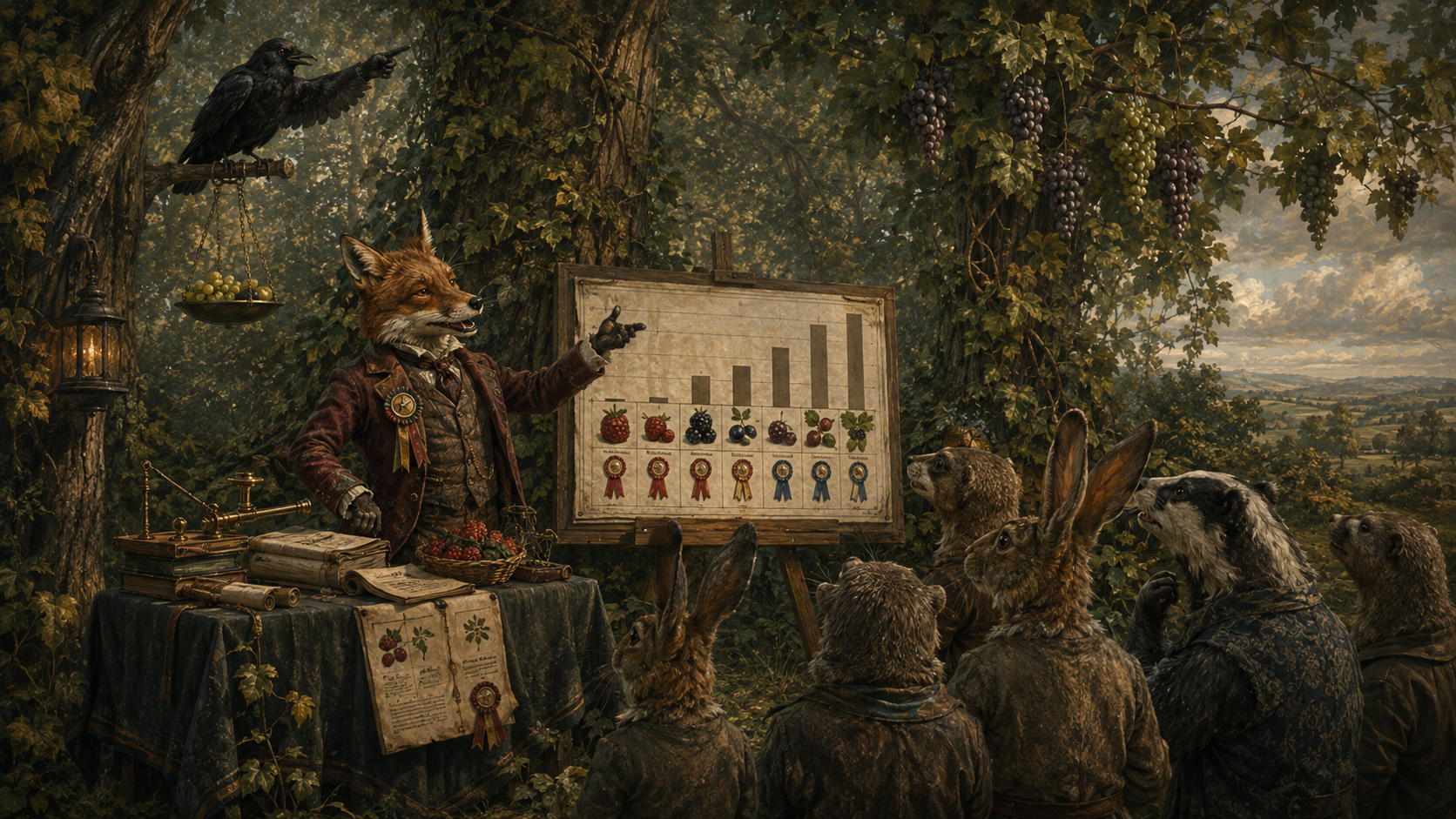
A fox spent a morning leaping at a cluster of grapes that hung well beyond his reach. This much is known.
What the older tellings omit is what the fox did next. He did not merely walk away declaring the grapes sour — that fox belongs to a simpler age. This fox went home and wrote an evaluation.
He began by defining fruit quality along the dimensions where he scored best. Lowness of hang: heavily weighted. Proximity to foxes: essential. Sweetness he acknowledged as “one consideration among many,” measured by a panel he selected, on samples he supplied. The high grapes, being unreachable, could not be sampled, and were therefore scored zero for availability — the single most important axis, per the methodology, which the fox had also written.
He published the results in a handsome chart. His own preferred berries, which grew at nose height along the fence he happened to own, achieved state of the art. The high grapes placed last, with a footnote questioning whether they could properly be called grapes at all, given the absence of independent verification — verification the fox had declined to seek.
The other animals were persuaded, for the chart was rigorous in every respect except the choice of what to measure. A crow, who could reach the high grapes and ate them daily, pointed out that they were in fact excellent. The fox thanked her for the anecdote and noted it was not peer-reviewed.
The grapes, for their part, remained exactly as sweet as they had always been.
Moral: Any contestant may excel on a course he drew himself. Before trusting a chart, ask who chose the axes — and whether the judge can reach the grapes he is scoring.
The fourth fable from Fables of the Walled Garden.