Jack’s mother owned three cows, and they were good cows: they gave milk every morning, they ate ordinary grass, and any farmer in the valley could tend them. But the valley was abuzz with talk of beans, and Jack was not a boy to milk cows while other boys climbed beanstalks.
At the market he met three merchants.
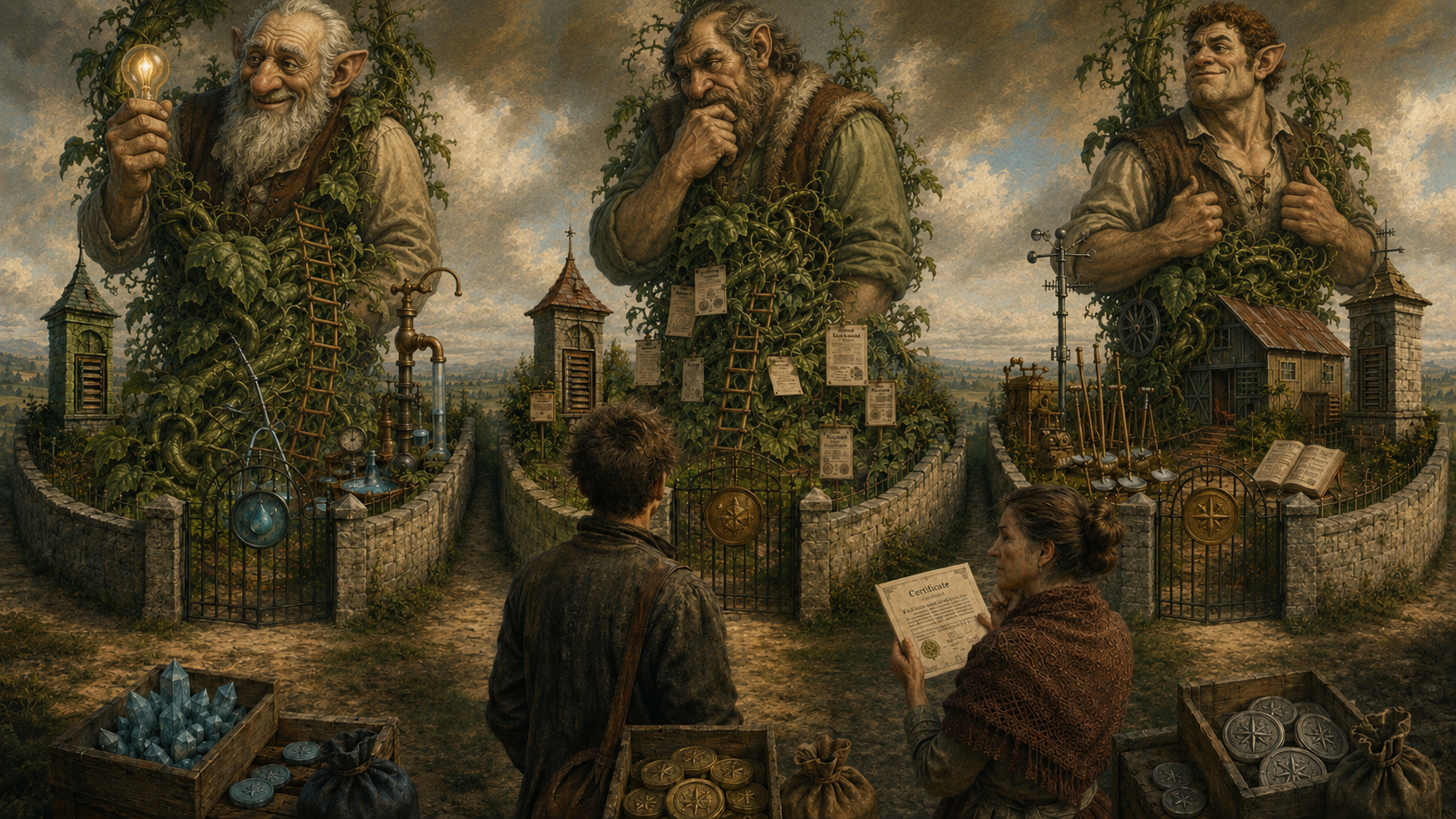
The first wore a leather jacket and sold beans of astonishing vigor. “These beans,” he said, “grow faster than any in the world. But they take root only in my garden, which I will lease to you, and they drink only my water, which I will meter.”
The second merchant was softer-spoken. “My beans are the safest beans ever cultivated,” he said. “I have written at length about the dangers of beans. Mine grow only in my garden also — for your protection.”
The third merchant said little, but his beans came bundled with the plow, the barn, the almanac, and the weather itself, and it seemed cheaper to take the whole bundle than to refuse any part of it.
Jack traded one cow to each merchant, for it seemed unwise to depend on a single bean.
By summer he had three magnificent beanstalks — and three gardens, each with its own soil that could not be mixed, its own water that could not be carried, and its own fence that could not be seen over. A stalk moved from one garden to another withered by morning. The ladders were incompatible. The fertilizer was sold in three currencies.
Jack’s mother asked the sensible question: “Are the stalks sound? Will they bear our weight?”
Jack asked each merchant. Each sent back a certificate, handsomely sealed, attesting that his own beanstalk had been inspected — by the merchant — and found excellent, according to standards the merchant had written, measured by instruments the merchant had built, summarized in a ledger kept in the merchant’s own tower, viewable for a small additional fee.
“But who has climbed them?” asked Jack’s mother.
“The merchants,” said Jack.
“And if a stalk is rotten, who tells us?”
“The merchant,” said Jack, more quietly.
In autumn a ladder gave way on the second stalk, and Jack fell far enough to think clearly on the way down. When he checked the certificate afterward, it still declared the climb safe. It had been true the day it was sealed, and no one — least of all the seal — was obliged to notice the day it stopped.
That winter the lease on the first garden tripled, for the merchant had counted Jack’s harvest and priced accordingly. Jack thought to move his crops to the second garden and found that nothing grown in the first could pass the fence: not the stalks, not the seeds, not even the records of what had grown, for the ledgers were written in a script only the first merchant’s clerks could read. The giant at the top of each stalk, it turned out, was the merchant himself — and the golden eggs were laid in his tower, in his currency, redeemable in his garden alone.
Jack’s mother sold the certificates for kindling, which was the only value anyone outside the gardens could extract from them, and observed that they burned very well.
Moral: He who cannot move his beanstalk does not own it. He who cannot carry his evidence out of the garden never had evidence — he had a receipt.