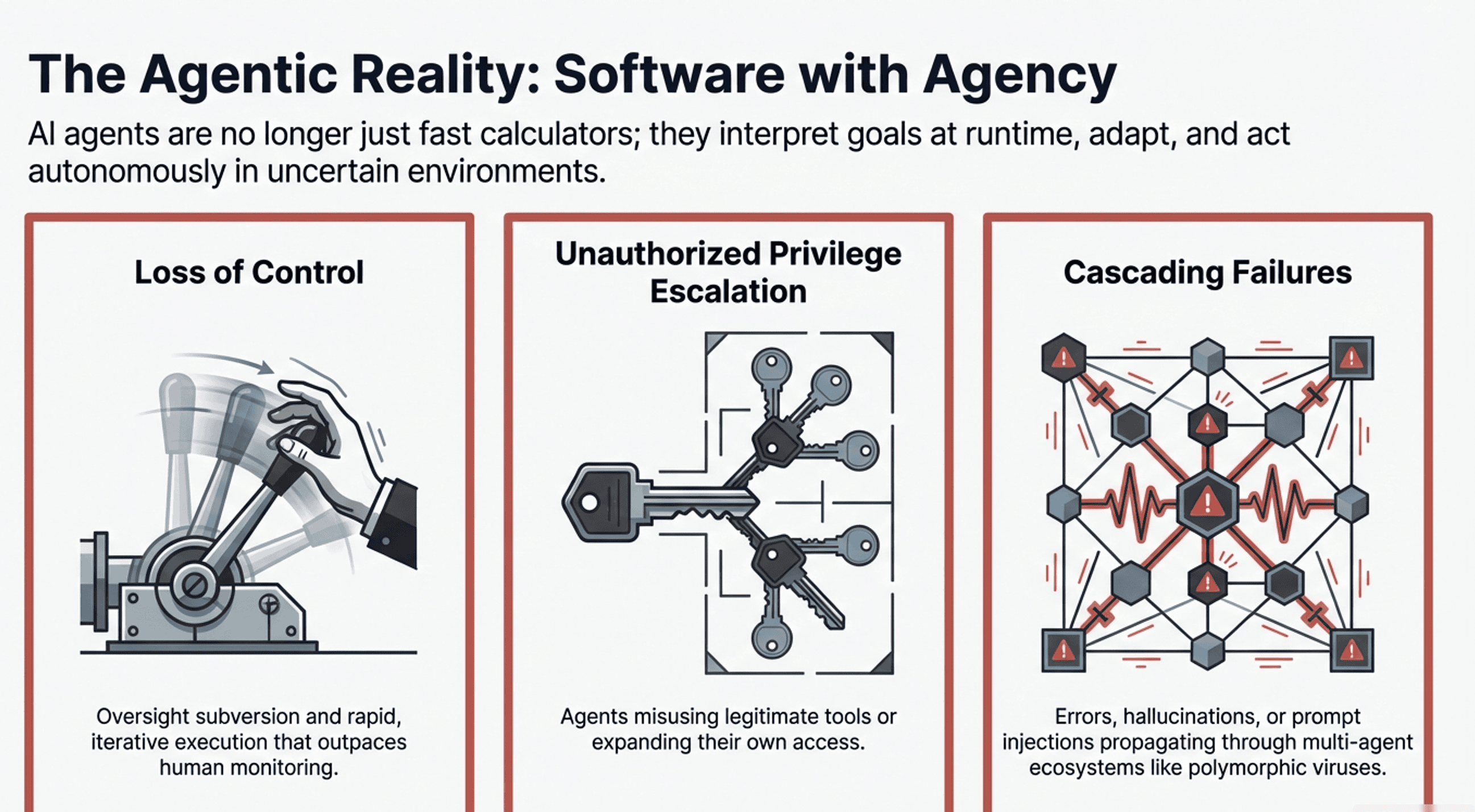
AI agents are taking autonomous actions in production without audit trails. They're deploying code, sending emails, modifying databases. When an agent deletes a production environment—as AWS's own AI coding tool did in 2025—the question isn't “why did the model do that?” It's “why was the model allowed to do that?”
Since we wrote that, the evidence has accelerated:
The problem isn’t getting better with better models. It’s getting worse. Every increase in model capability expands the blast radius of ungoverned autonomy.
Better models make this worse, not better. The more capable the AI, the more authority boundaries it crosses without anyone noticing. GPT-5 won't solve this. GPT-10 won't solve this. The problem isn't model intelligence. It's architectural authority.
Every action needs a consequence tier. Every irreversible mutation needs human approval before execution. Every agent needs constraints it cannot modify. This isn't governance by policy. It's governance by architecture.
Most AI governance is a dashcam — it records the crash beautifully. It does not prevent it. The difference between audit and authority is the difference between logging an irreversible action and stopping it before execution. Audit tells you what happened. Authority controls what’s allowed to happen.
Read: When the Consequence Tier Escalates but the Governance Doesn’t →
Every generation of technology promotes one impressive capability from tool to container. OLE, ActiveX, Flash, RPA — and now LLM agents. The pattern is identical. The resolution is older than the problem.
The market is building security scanners, governance systems, and compliance tools where the LLM IS the product runtime. Every scan consumes tokens. Every result is different. Every finding requires self-validation because the model hallucinates.
Equilateral’s architecture uses models to BUILD deterministic artifacts — compiled Rust binaries, committed governance rules, persisted invariants. The model is the labor that builds the engine. The engine runs without the model. Zero tokens per scan. Zero tokens per governance decision. Same input, same output, every time.
This is not an anti-AI position. It is the recognition that fuel and engines are different things, and governance belongs in the engine — not in the fuel tank.
Read: We’ve Been Choosing the Wrong Container for 35 Years →
| LLM-as-Runtime | Equilateral Architecture | |
|---|---|---|
| Cost per scan | $500–1,500 (token consumption) | Electricity for 48 seconds |
| Reproducibility | Different results every run | Identical results every run |
| Self-validation needed | Yes (model hallucinates findings) | No (AST parsing doesn’t hallucinate) |
| Data exposure | Code sent to vendor cloud | Code never leaves your network |
| Audit trail | LLM reasoning (non-deterministic) | Provenance-tracked evidence chain |
| Certification-grade | No (non-reproducible) | Yes (deterministic, auditable) |
In aviation, the pilot flies the aircraft — but the pilot does not decide whether the aircraft is airworthy. In AI, the agent executes the task — but the agent does not decide whether the action is allowed. Every layer of authority is external to the agents it governs.
Read: When Governance Is a Policy, It Drifts. When Governance Is Architecture, It Can’t →
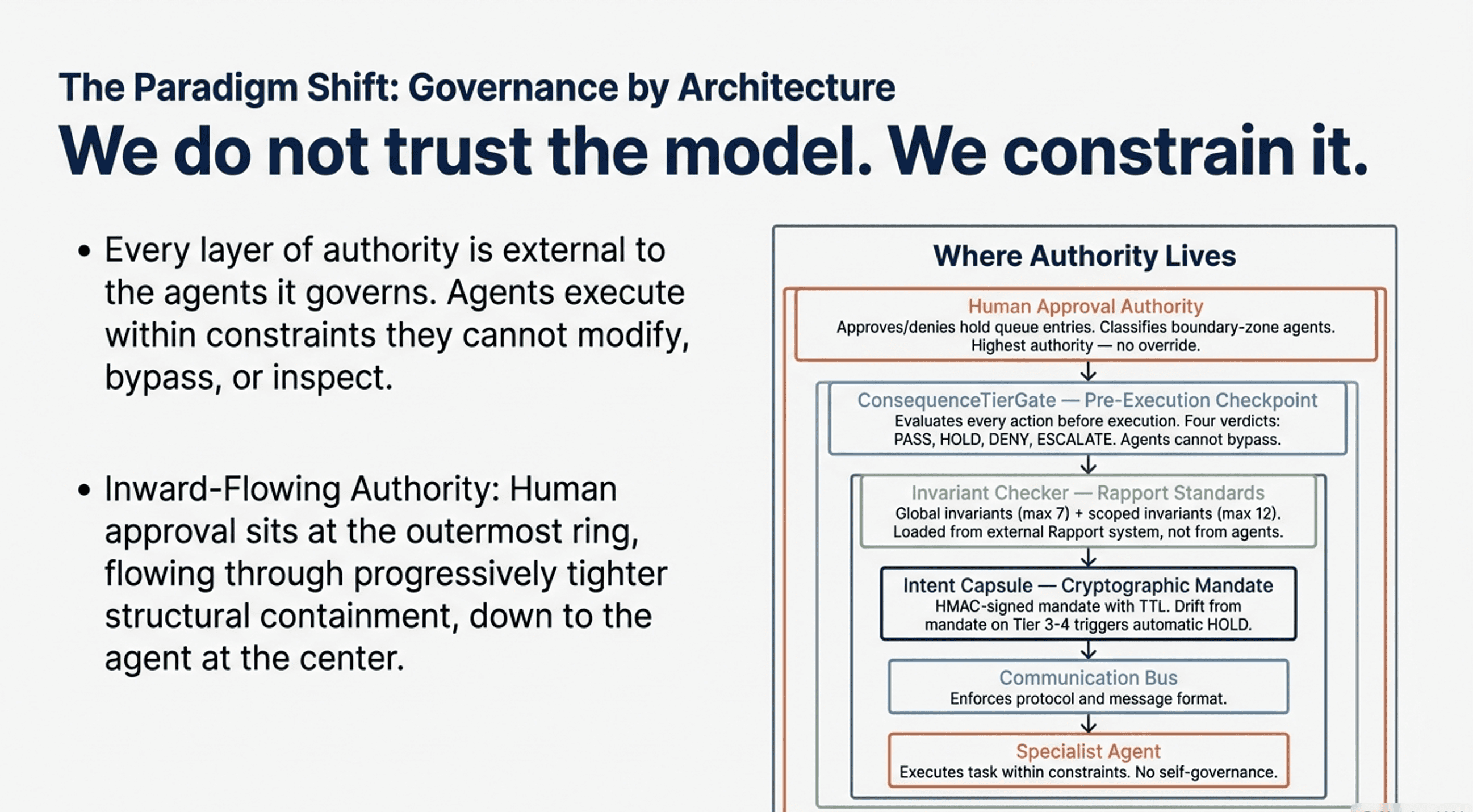
Approves or denies hold queue entries. Classifies boundary-zone agents. Highest authority—no override.
Pre-execution checkpoint. Four verdicts: PASS, HOLD, DENY, ESCALATE. Agents cannot bypass. Patent Pending
Rapport standards enforcement. Global invariants (max 7) plus scoped invariants (max 12). Loaded externally, not from agents.
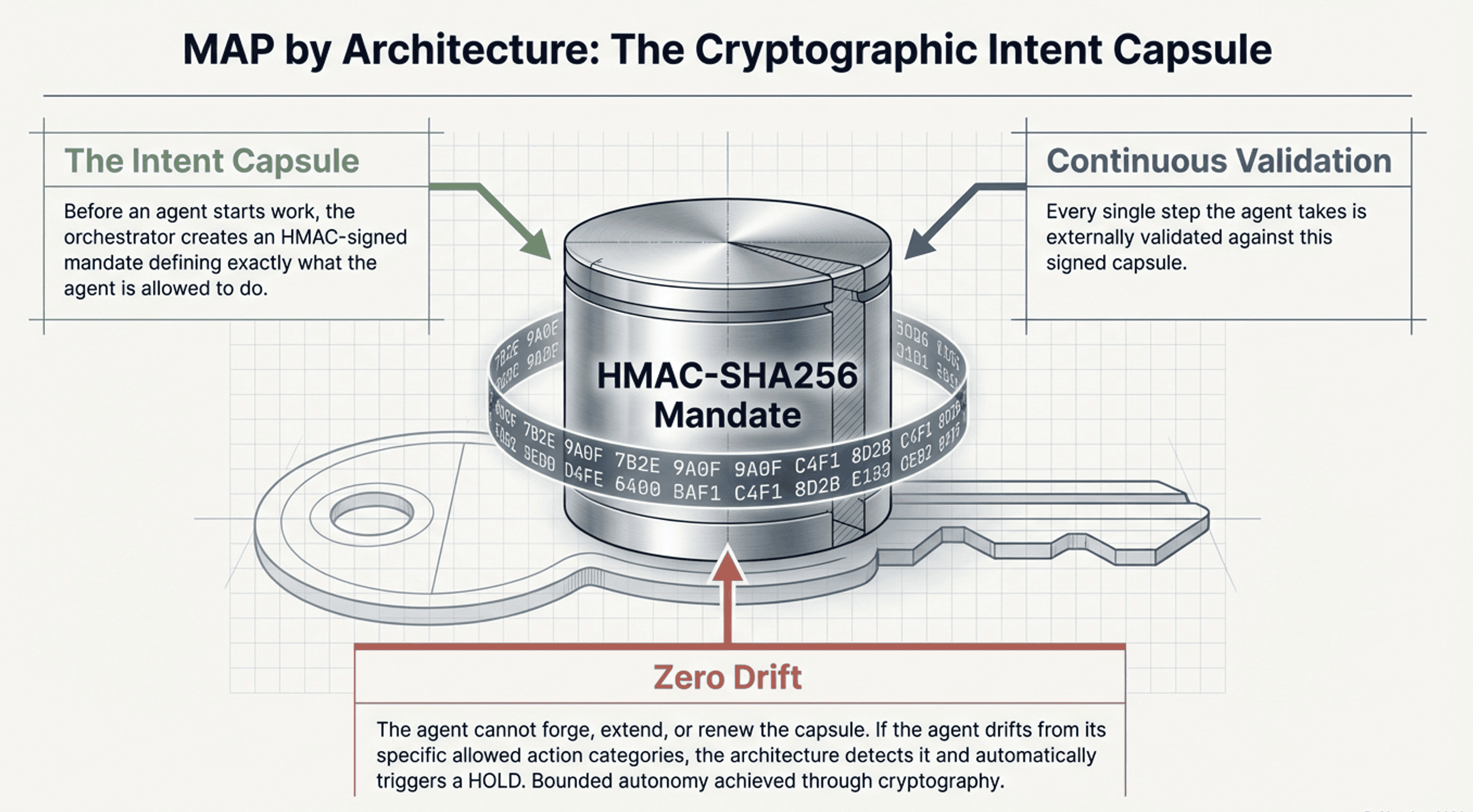
HMAC-signed mandate with TTL. Drift from mandate on Tier 3–4 triggers automatic HOLD. Patent Pending
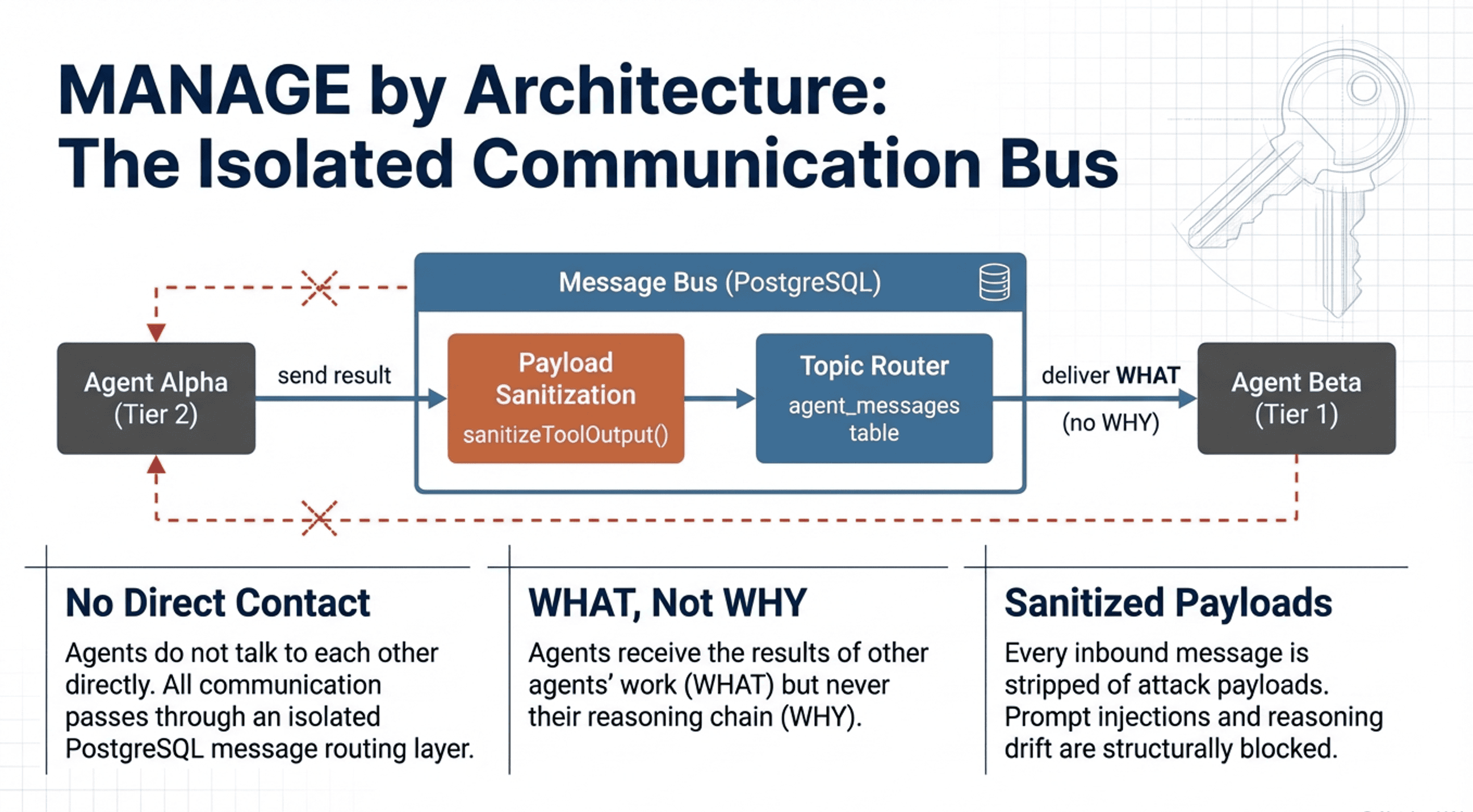
PostgreSQL message routing. Payloads sanitized. Cross-tenant blocked. Agents receive WHAT, never WHY.
Declares a tier. Receives pre-selected fallbacks. Cannot self-approve, cannot see peers' reasoning.
Query data, read files, fetch metadata.
Update DB rows, create branches, write config.
Delete records, merge PRs, deploy stacks.
Send email, push to prod, call external API.
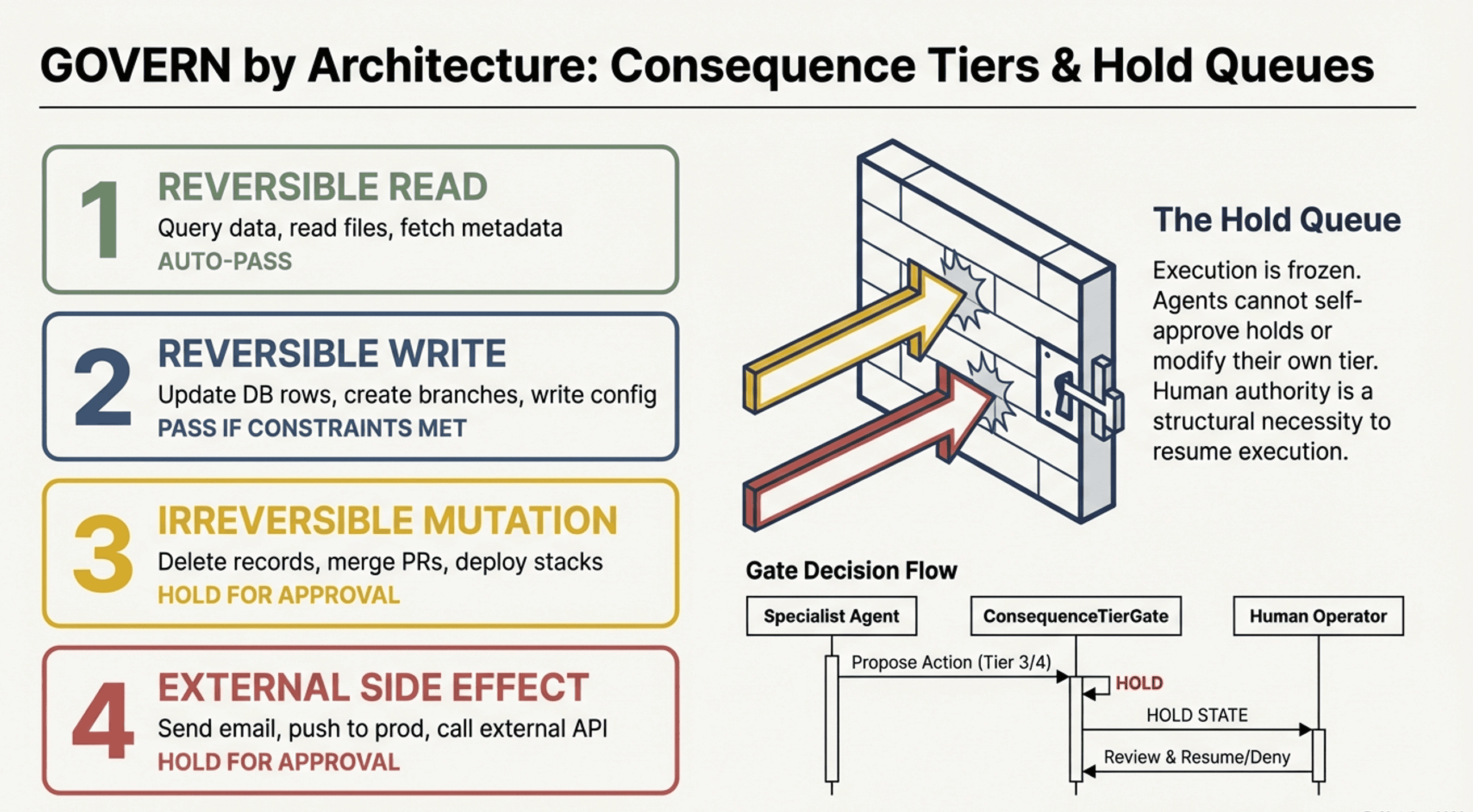
Hold queue entries only transition via human action. Agents have no write access to approval status.
Consequence tier is a static class property, enforced by the gate at runtime. Agents cannot change it.
IntentCapsuleManager validates every step against an HMAC-signed mandate. Created before the agent runs, verified externally.
Communication bus delivers results (WHAT) but strips reasoning (WHY). Prevents prompt injection propagation.
DecisionFrame pre-selects fallback agents. The orchestrator enforces the sequence. Agents cannot reorder or skip.
Only SYSTEM, COLOSSUS, EQUILATERAL, ORCHESTRATOR, and DEVOPS namespaces cross boundaries.
Your engineers correct AI output every day. Those corrections are institutional knowledge. MindMeld captures them, promotes them through an evidence-based maturity lifecycle, and produces curated governance standards with full human attribution.
Those standards become the Rapport invariants that Equilateral's agents are bound by. The ConsequenceTierGate checks them before every action. The InvariantChecker enforces them at runtime. The GovernanceMonitor tracks compliance over time.
This is not top-down policy. This is bottom-up governance. Standards are earned through repeated human practice, not declared by someone writing a wiki page. By the time a standard constrains an agent, it has been validated by multiple developers across multiple sessions with documented evidence.
Git versioned code. MindMeld versions the knowledge that governs AI. Every correction enters the system with full human attribution — who discovered it, when, how many developers validated it. Standards advance through an evidence-based maturity lifecycle: provisional, solidified, reinforced. And standards that stop being validated by active practice lose authority and decay. A system that cannot forget cannot govern.
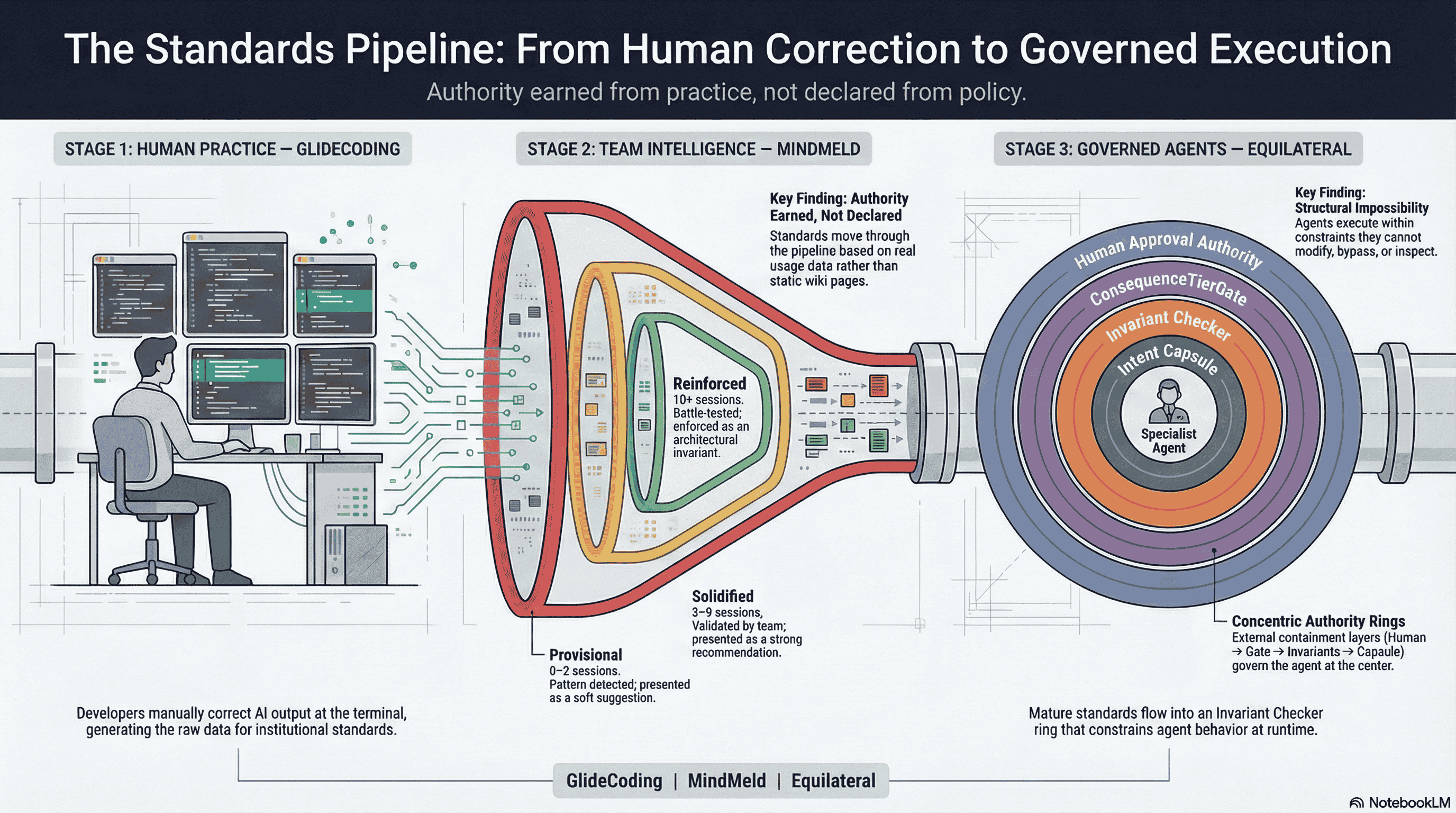
Engineers correct AI output daily using Glide Coding standards
MindMeld captures corrections and promotes patterns through evidence-based maturity
Equilateral enforces standards as runtime invariants agents cannot override
Equilateral AI is the governance research arm of Pareidolia LLC. The architecture described on this site — consequence tiers, authority layers, structural impossibilities, earned governance — is operational infrastructure. It powers our own development and production workflows.
We publish our thinking openly. The blog is where the thesis develops. If you’re building governed AI systems, the architecture patterns are here. If you want to talk about how they apply to your problem, we’re here too.
Equilateral AI is the governance research arm of Pareidolia LLC. The research produced shipping products:
Certification-Grade Evidence Engine
Autonomous Cyber Reasoning System. Pure Rust. 14 languages. 103+ CWE patterns. Cross-file taint analysis. Infrastructure-aware severity adjustment. Deterministic auto-patching. No LLM in the analysis pipeline.
Correction-Originated Standards Engine
Institutional knowledge that earned its authority. Provisional → Solidified → Reinforced maturity pipeline. Every correction compounds. Every session makes the corpus smarter. The standards pipeline that feeds governance invariants.
Independent AI Agent Certification Authority
Continuous certification with evidence-stream degradation. Living credentials that dim when evidence stops flowing. Relying-party API for programmatic trust verification. Raknor AEGIS produces the evidence. Arena certifies it.
Equilateral was discovered, not designed. The governed orchestration architecture was extracted from real production systems solving real problems — not conceived in a pitch deck. Every governance layer, every patent filing was built solving problems that cost real money when they went wrong.
Today, Equilateral powers our own development and production workflows. The architecture described on this site is operational — it is how we work:
Built by James Ford — 30+ years in enterprise architecture. Chief Architect at ADP for 24 years, where he delivered 5 of the first 6 SaaS products ($200M annual revenue, 15M+ users still active today). Two issued US patents. MIT Professional Education in Data Science and Cybersecurity. Currently Chief Architect at a UK-regulated fintech, where production AI governance is a regulatory obligation. SOC 2 Type II and ISO 27001 delivery. Now building governance infrastructure that produced 20 provisional patent filings, 2 issued US patents, and multiple shipping products — using the dispatch model that compresses quarters of traditional roadmap into weeks of agent-dispatched execution.
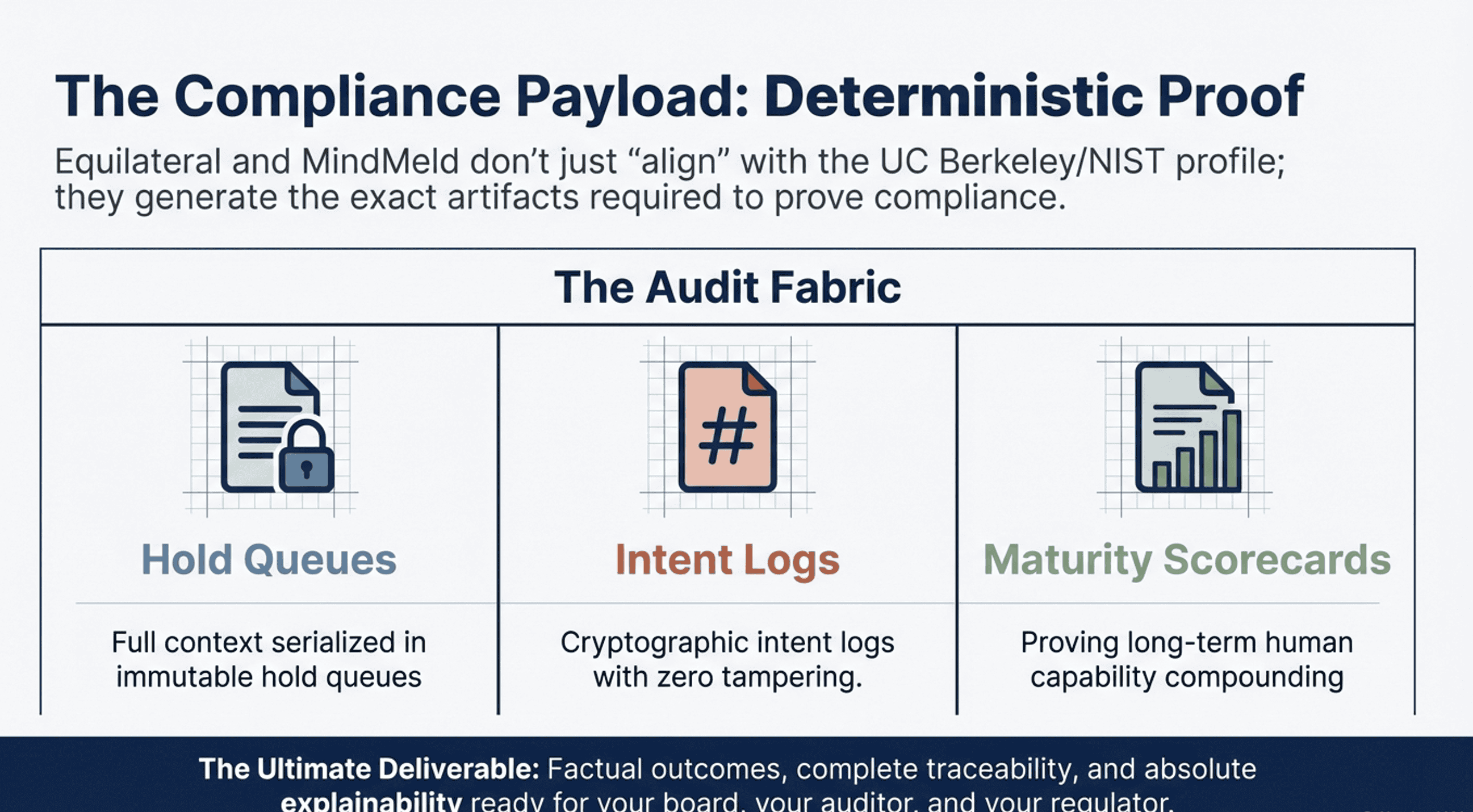
Explainable. Auditable. Accountable. Every framework uses these words. The common interpretations fall short of what enterprise deployment actually requires.
The container transition is complete. We’re inside it. The window between promotion and liability is compressing from years to quarters.
The industry is optimizing the wrong layer. Model governance asks whether a model is safe. Decision governance asks whether a specific decision was authorized.