
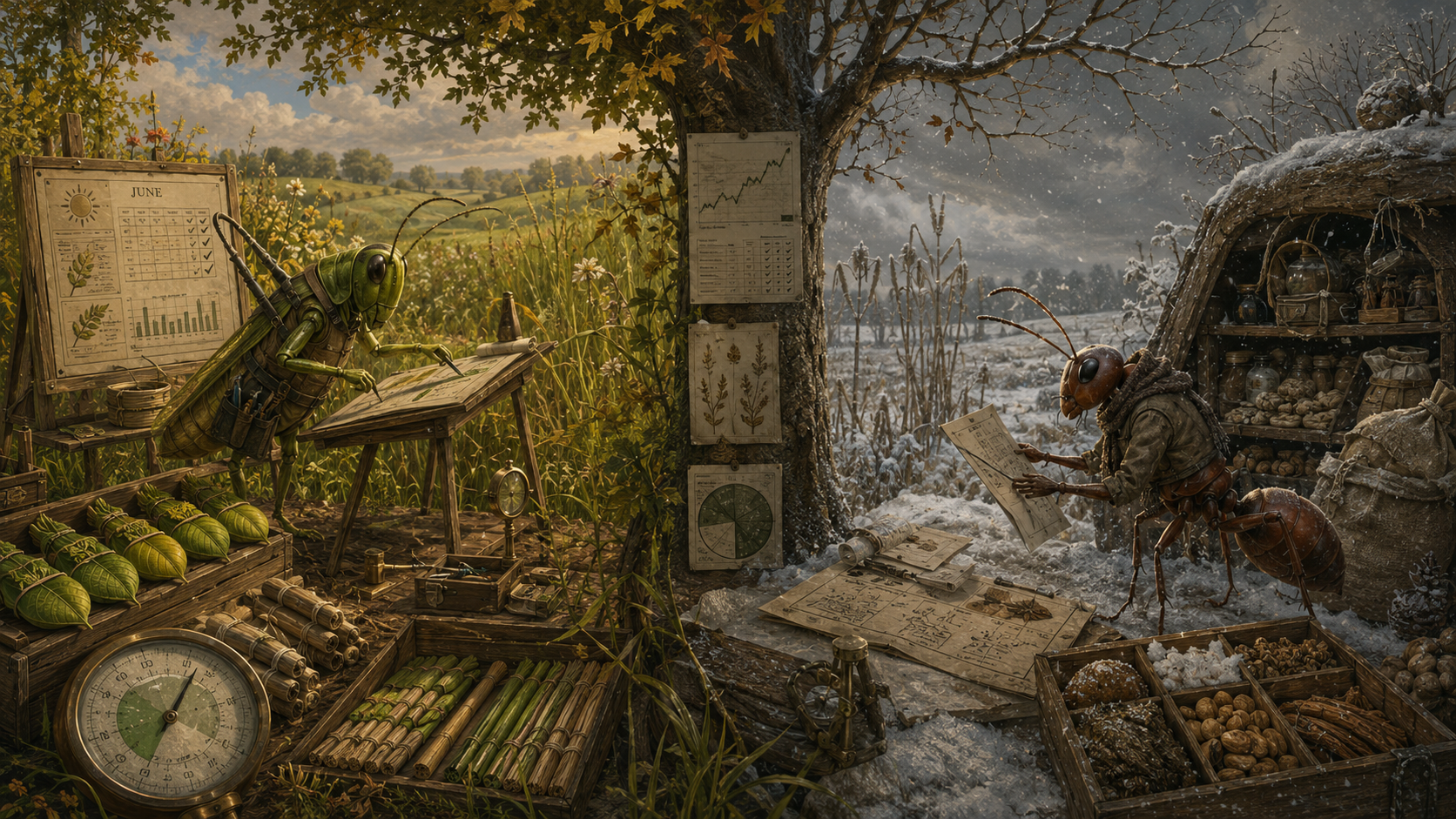
The retellings have been unkind to the grasshopper, painting him as idle. He was not idle. He was, by every measure available in June, the most productive creature in the meadow.
All summer he executed flawlessly. Asked to gather, he gathered; asked to build, he built; his output was abundant, his error rate negligible, his speed the envy of the ants. Every task was completed exactly as specified. The specifications had been written in June, when the world was warm, and they said nothing about winter, because in June nobody writes about winter.
The ant worked more slowly, and appeared, frankly, to waste a good deal of time. She kept stopping to check her stores against a question no one had assigned her: will this keep us alive in January? When the weather shifted in September she threw out half her summer’s assumptions and reworked them, which looked, on any dashboard the meadow might have kept, like rework, delay, and regression.
October came. The grasshopper’s work was audited and found perfect — perfectly aligned with June. Every deliverable matched its specification. It was a monument to fidelity of execution, and it was useless, because the intent behind the specifications had been survive the year, and no one had been assigned to notice when the world stopped resembling the assumptions.
The grasshopper had not failed at anything he was measured on. That was precisely the problem. The distance between what was asked in June and what was needed in December had grown all season, quietly, in the gap between the measures — and nothing in the meadow was responsible for measuring the gap itself.
The ant survived the winter. Not because she worked harder, but because she was the only one auditing the question instead of the answers.
Moral: Perfect execution of a stale intent is a slow-motion failure that passes every review. Someone must own the distance between what was asked and what is now needed — for that distance grows in silence, and it is always someone’s winter by the time it speaks.
The fifth fable from Fables of the Walled Garden.